Best Mini Split for a Basement

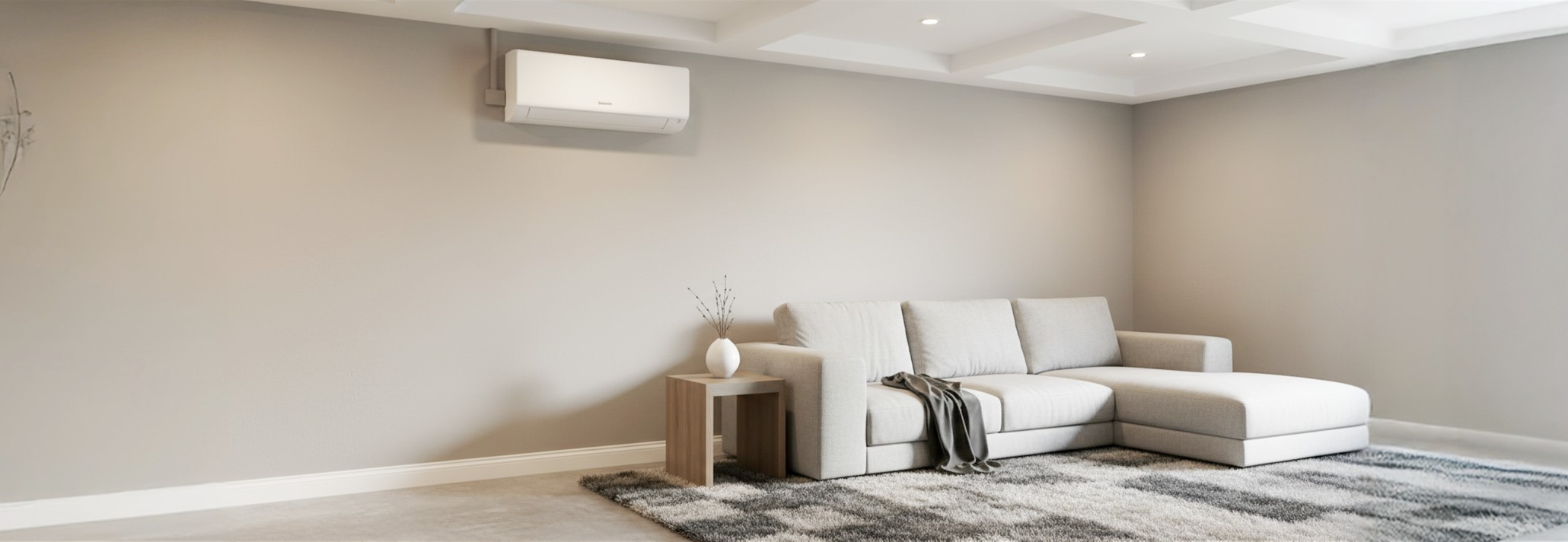
- What Makes Basements Challenging?
Basements present three unique issues:
- Moisture & Humidity Control
Below-grade walls and limited airflow normally mean higher humidity.
A mini split must be able to remove moisture efficiently — especially in summer.
See: extend mini split lifespan for ongoing maintenance tips to keep moisture control strong.
- Reliable Heating in Cold Areas
Because basements stay several degrees cooler than above-ground rooms, choosing a model with strong low-temperature heating is essential.
If you live in an extreme winter climate, review our mini splits for cold climates guide before choosing your unit.
- Quiet Operation
Basements often double as offices, gyms, guest suites, or media rooms. A noisy system quickly becomes distracting.
Bedroom-level noise performance is ideal.
- What Size Mini Split Does a Basement Need?
Most finished basements range between 400 and 1,000 sq ft, but insulation, ceiling height, and layout matter.
Use this quick reference:
| Basement Size | Recommended BTU |
| 300–450 sq ft | 9K–12K BTU |
| 450–650 sq ft | 12K–18K BTU |
| 650–1,000 sq ft | 18K–24K BTU |
If your basement is divided into multiple rooms, consider MRCOOL multi-zone mini split systems (Link 16) so each room can be sized independently.
For exact sizing, compare your numbers with the full What Size Mini Split Do I Need? chart.
If your basement has long refrigerant runs to the outdoor unit, reference our mini split line set lengths guide to ensure proper performance.
- Moisture: The #1 Basement Sizing Adjustment
Basements create higher latent loads (moisture) than typical living spaces. This affects sizing in two ways:
- Don’t oversize.
Oversizing causes the system to cool too quickly, reducing the time it needs to remove humidity.
This leads to a cold but clammy space.
- Choose inverter models with strong dry mode.
Inverter-driven mini splits, like MRCOOL’s DIY and Pro Install lines, naturally run longer at low speeds — ideal for moisture removal.
- Add a standalone dehumidifier if humidity is extreme.
Mini splits regulate humidity well, but in very wet basements, pairing them with a dedicated dehumidifier creates a perfect balance.
- Heating Performance: What Basements Really Need
Because basements sit partially or fully underground, they stay cooler year-round.
For reliable heating:
- Choose a model with high HSPF2 performance
- Avoid budget systems that lose capacity in cold weather
- If your climate has harsh winters, review mini splits for cold climates
-
- For whole-home basements or large open spaces, consider MRCOOL central heat pump systems
-
Most homeowners in cold or mixed climates should size according to the upper end of the BTU range.
- Noise Levels: Selecting the Quietest Mini Split for a Basement
If your basement doubles as a:
- home theater
- home office
- gym
- guest suite
- hobby space
…then low noise is a top priority.
Look for:
- Indoor unit noise levels at ≤ 24–29 dB
- Outdoor units placed far from windows or living areas
- Inverter compressors that operate quietly at partial load
If you need multi-room zoning, see how zoning works in mini split systems — it explains how to distribute quiet indoor heads throughout the basement.
- Best MRCOOL Options for Basements
Below are the basement-friendly choices depending on size, moisture, and cold climate needs.
Option 1: MRCOOL DIY 5th Gen Single-Zone
Ideal for finished basements up to ~1,000 sq ft (depending on layout).
Choose from: 9K, 12K, 18K, or 24K BTU.
Why it works well:
- Excellent humidity control via inverter operation
- Very quiet indoor unit
- DIY-friendly installation
- Strong heating for moderately cold climates
- Smart control + WiFi
See the full lineup here: MRCOOL DIY single-zone systems.
Option 2: MRCOOL Multi-Zone (If You Have Multiple Basement Rooms)
Perfect for basements with:
- a media room + bedroom
- a gym + office
- a workshop + living area
Each room can be sized exactly to its BTU needs.
Option 3: MRCOOL Universal / Central Heat Pump Systems
If your basement ties into a larger whole-home plan, or your climate requires extremely stable winter heating, consider:
MRCOOL central heat pump systems.
These handle:
- large basements
- long duct runs
- whole-house zoning
- extreme cold climate performance
- Real-World Basement Examples
Example 1: 550 sq ft finished basement (Moderate Climate)
→ 12K–18K BTU
The MRCOOL DIY 18K is typically the best match.
Example 2: 800 sq ft open basement (Cold Climate + High Humidity)
→ 18K–24K BTU
Go with 24K if winters are severe.
Example 3: 2-room basement (300 + 300 sq ft)
→ 9K + 9K BTU
Pair with a 24K multi-zone condenser.
If you’re unsure whether you should install it yourself or hire a pro, compare options in DIY vs pro mini split installation.
- When to Size Up or Down in a Basement
Size UP if your basement:
- Has poor insulation
- Has high humidity
- Has tall ceilings
- Is located in an extreme climate
- Includes a gym or media room you heat/cool heavily
Size DOWN if your basement:
- Is exceptionally well insulated
- Is naturally cool
- Is shaded and stable
- Has low ceilings
- Has a supplemental dehumidifier
To see what comes in the box before choosing, check what’s included in a MRCOOL DIY kit.
- Final Recommendation
Basements require a mini split that balances moisture control, quiet operation, and reliable heating. Most homeowners find their best fit in:
- MRCOOL DIY single-zone systems for 1-room basements
- MRCOOL multi-zone systems for divided basements
- MRCOOL central heat pumps for whole-home or large-space conditioning
For confirmation, or if your basement layout is complex, you can always talk to an expert for guidance.
FAQ
What size mini split do most basements need?
Most basements fall between 12K–24K BTU, depending on size and moisture level.
Use our mini split sizing guidance for tailored recommendations.